Monday, September 6, 2010
Query about Latinos in Video Games
Any others that you all might have come across? Would greatly appreciate any leads.
G...racias
Tuesday, August 3, 2010

Over a Peet’s coffee—black and no sugar--I chatted with Angela Becerra Vidergar, co-founder of the Graphic Narrative Project at Stanford, about end-of-days novels and films, Latin American Boom authors, and, well, comic-books. Since my days at Stanford in the mid- late- (nineteen)nineties, it seems there’s more interest in this storytelling form beyond the literature departments (English, Comparative, and Rhet-Comp); even there it was few and far between. Now it seems all sorts are taking more than a passing interest, including faculty from Archeology, Engineering, Math, and the Arts—including Scott Bukatman and John S. Knight Fellow Dan Archer.
Comic books on any syllabus seem to be drawing the undergrad crowds. Angela’s Rhetoric of Comics even teased out of an engineering student a paper that used the kind of research I’m partial to from the cognitive- and neuro- sciences. And, with some Humanities Center dollar-backing, Angela along with co-founder Haerin Shin’s Graphic Narrative Project will bring to Stanford various (2010-2012) invited guests to run colloquia and as well as host a series of speaker events; if I’m lucky, there might even be one on cognitive approaches to comics and another focused on Latino comics.
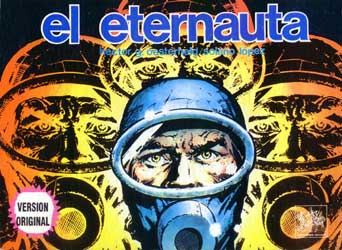
The brushfire that’s happening at Stanford’s been going on elsewhere, too. Of course, we have this all going down at OSU not just in my classes, but also with my colleague Jared Gardner’s Mario-X-sized popular course on comic books; so big that he had to move twice to get a lecture hall super-sized enough to fit them all. After talking about Angela’s possible dissertation focused apocalyptic narrative fiction, I learned of Argentinean Hector Osterheld, his sci-fi comic El Eternauta, and his joining Montoneros leftist guerilla that led to his kidnapping and disappearance during the Dirty War. And, we both agreed that while the so-called Boom put Latin American authors on the map—Cortázar, Fuentes, GGMárquez, and the like—in the glorying over the novel, a glare left out the short story. So we know Cortázar for Hopscotch and not for his mind-blowing moebius-strip fictions; we know of the Buendias, but not of GMárquez’s formidable Geneva-set fact-fictions of ex-dictators. We do know of Latin America as homo faber in the realm of the short narrative form, but only in the single, solitary Borges. Had he published a novel, those north of the Tortilla Curtain would probably know little of his ficciones.
In El Defectuoso (the megalithic D.F.) and also Buenos Aires and Caracas authors and theorists are tearing it up with the flash fiction form (a.k.a microcuentos, microrelatos, or minificciónes constrained by 250 words), only seemingly recently “discovered” by US practitioners like J.E. Wideman, Junot Díaz, Juan Felipe Herrera, Luis Rodriguez, Luis Urrea, Ana Castillo, Sandra Cisneros.
In a tetris-game shuffle that moves edges to centers, in the US academia comic books--and now flash fiction--are here, and seemingly to stay.
Saturday, July 31, 2010
Stanford's Graphic Narrative Project
http://www.stanford.edu/group/gnarp/cgi-bin/drupal/
Friday, April 23, 2010
Multicultural Comics: From Zap to Blue Beetle
Sunday, April 18, 2010
The Lantern - Professor lectures on Latino comics
Professor lectures on Latino comics
By Zach Asman
asman.14@osu.edu
Published: Wednesday, April 14, 2010
Updated: Wednesday, April 14, 2010
A small crowd scattered among a classroom in William Ox;ley Thompson Memorial Library to see professor Frederick Luis Aldama’s presentation on Latino comic books and graphic novels.
The presentation, titled “Your Brain on Latino Comics,” takes the same name as Aldama’s book, released in 2009 and published by the University of Texas Press.
“Nobody knows about Latino comics, and yet there are a lot of these guys doing this work and a lot of people reading the stuff, it just hasn’t been archived,” said Aldama, 41. “People haven’t made an academic attempt giving it visibility like Faulkner and all these guys when you mention their name everybody knows about.”
After engaging the crowd and finding out what its favorite comic books and graphic novels were, Aldama went on to speak for more than 45 minutes about things such as the history of Latino comic books and the representation of Latino characters in mainstream comics and graphic novels. The entire lecture was accompanied by a PowerPoint presentation and was followed by a question and answer session with the crowd.
Some of the many items discussed by Aldama included the Hernandez Brothers long-running series “Love and Rockets,” El Dorado, a character in the popular comic series “Super Friends,” and Vibe, a product of DC Comics.
This is not the first book written by Aldama, whose other works include “Postethnic Narrative Criticism, Brown on Brown,” “Why the Humanities Matter: A Common Sense Approach” and 2008’s “Dancing With Ghosts: A Critical Biography of Arturo Islas,” which received an MLA award.
“His work in general is just really strong,” said Evan Thomas, a 23-year-old graduate student studying English. “He’s got an interdisciplinary that gives him a strength and adaptability that will really serve him in the long run.”
Aldama also spoke about the academic merits of comic books and graphic novels being used in the classroom. Not only does Aldama use them as a part of all of his classes, but in the past few years the university has introduced several classes with curriculum based upon comic books.
“Comic books, just like novels, can be simple minded or they can be completely complex and interesting,” said Aldama. “By writing books and publishing them with academic presses, what it does is it works sort of top down to give legitimacy to it as a very carefully crafted storytelling mode.”
Nancy Courtney, coordinator of outreach and engagement for the libraries, said that the event was put on by OSU Libraries as a part of its ongoing Humanities series.
Monday, April 5, 2010
ReadAloud Special : Latino Comics Program
The Ohio State University
Thompson Library Room 165
April 13, 2010 4-5 pm
I will be discussing my work by and about Latinos in comics based on my book, Your Brain on Latino Comics. I will lecture on mainstream comic book representations of Latino superheroes from the late 1970s till today as well as how Latino author/artists working today use the visual and verbal elements of the comic book medium to affect the cognitive and emotional responses of their readers.
http://library.osu.edu/blogs/outreach/
Full-spectrum comics An encyclopedia of graphic cultura
Courtesy Photo
Art from Love and Rockets by Jaime Hernandez
Art
Full-spectrum comics
An encyclopedia of graphic cultura
by Patricia Portales
(Available http://www.sacurrent.com/printStory.asp?id=70495)
In 1954, the Senate Subcommittee on Juvenile Delinquency recommended that comic-book publishers censor their amoral and violent storylines — thanks largely to the findings of
psychiatrist Fredric Wertham, who believed Batman and Robin’s relationship was suspicious and Wonder Woman’s lifestyle was anti-masculine — lest they corrupt the children.
If Wertham interpreted Wonder Woman’s rescue missions, which often interrupted her secretarial duties, as a threat to male authority, I wonder how he would have responded to Laura
Molina’s 1996 comic book Cihualyaomiquiz, the Jaguar, in which law student by day/superhero warrior by night Linda Rivera fights California’s militarized police and corporate capitalists. And he probably would have been alarmed by Ivan Velez’s Tales of the Closet, which illustrates the closeted life of Tony, Scotty, Ben and other LGBT teenagers who experience
alienation and violent hate crimes in and out of their school in Queens.
In Your Brain on Latino Comics: From Gus Arriola to Los Bros Hernandez, Frederick Luis Aldama examines the ways in which Latino author-artists contributed to the reemergence of the
comic-book industry following the restrictive 1950s, when it was rare for Latinos to be represented by anyone other than a heavily accented caricature. Latino comic-book auteurs,
many of whom started their careers in the alternative and underground comics of the 1980s, have developed psychologically complex characters who have smashed Latino and other stereotypes, “radically extended[ing] the alternative-comic-book storytelling mode in various ways while they detail the everyday firmly located within a larger society.”
Aldama profiles several comics populated with highly complex characters who suffer alienation in societies plagued by equally complex problems: crime, violence, rampant consumerism, racism. Wilfred Santiago’s ultra-morbid In My Darkest Hour, published by Fantagraphics, illustrates the life of anti-hero Omar Guerrero, who self-medicates to endure the psychic trauma of living in a violent society: “We all rot. Soon I’ll be nothing. Why bother with the triviality of ethics that are nothing more than man’s invention?” His musings are followed by a morose
contemplation of each cigarette he smokes: “It will take me seven minutes to finish this cigarette. Each cigarette snuffs eleven minutes out of you.”
Citing Los Bros Hernandez’s Love and Rockets, Molina’s Cihualyaomiquiz, the Luna Bros’ Ultra, Anthony Oropeza’s Amigoman, and Rafael Navarro’s Sonambulo, among others, Aldama argues that each author-artist’s innovative techniques developed the visual and verbal narrative available to characters of color. In part one of three, Aldama offers a history of Latino and African-American characters — often short-lived and stereotyped — such as DC’s El Dorado in Super Friends and Marvel’s Sam “Snap” Wilson, the Falcon in Captain America. Crediting the influence of the Civil Rights Movement of the 1960s and the Culture Wars of the 1980s, Aldama
tracks the rise of realistic, multidimensional characters of color in the 1990s in Milestone’s Blood Syndicate, Azteca Productions’ El Gato Negro, and Jose Martinez’s Chosen Comic’s The Chosen, which first appeared at ComiCon in 1995.
Twenty-one interviews with the author-artists comprise the book’s third section, and what a gem it is. Gus Arriola, author-artist of the 40-year-old strip Gordo, shares his beginnings as Columbia Screen Gems illustrator for the series Krazy Kat and other minor cartoons during the Great Depression. El Gato Negro creator Richard Dominguez discusses Marvel’s and DC’s buyout of distributors and its effect on his work. Roberta Gregory, currently working on her novel Mother Mountain, admits that writing and illustrating a graphic novel would take too long. El Muerto creator Javier Hernandez relates the story of the one-and-a-half minute NPR interview that led
to the film adaptation featuring Wilmer Valderrama in the title role. Aldama focuses largely on comic books and devotes very few pages to comic strips, seemingly because Latino produced
comic books outnumber strips, but he does include Dupie: The Life and Times of a College Student as Seen through the Pen of Campus Cartoonist, Gil Morales, which ran in the Stanford Daily for four years, Lalo Alcaraz’s politically charged La Cucaracha, and David Gonzales’s comic-strip-turned-plastic-figurines Homies. Still, the book is a storehouse of information for any would-be comic aficionado, and like Aldama, urges the reader to further his or her own study of Latino comics.
Your Brain on Latino Comics:
From Gus Arriola to Los Bros Hernandez
By Frederick Luis Aldama
University of Texas Press
$24.95, 331 pages
© 2010 San Antonio Current
San Antonio Current http://www.sacurrent.com/printStory.asp?id=70495
2 of 2 4/5/10 11:09 AM